







55502603
Brennstoffzelle
In 10 interaktiven Aufgaben und interaktiven Videos wird Wissen zu Brennstoffzellen vermittelt und anschließend abgefragt.
Das Medium bietet H5P-Aufgaben an, die ohne zusätzliche Software verwendbar sind.
Durch interaktive Aufgabentypen wird das audiovisuelle und interaktive Lernen einfach.
Lernen macht jetzt Spaß!
Included Tasks
- I Energiequellen - Video mit interaktiven Aufgaben
- II Was ist eine Brennstoffzelle? - Lückentext
- III Wirkprinzip: kalte Verbrennung - interaktives Video
- IV Vorteile der Brennstoffzelle - interaktive Aufgabe
- V Elektrolyse und Wasserstoffbrennzelle - interaktive Aufgaben
- VI Kraft-Wärme-Kopplung und Brennstoffzelle - interaktiver Vergleich
- VII Geschichte der Brennstoffzelle - interaktive Zeitleiste
- VIII Brennstoffzellen im Alltag - interaktive Aufgabe
- IX Wissenskarten - interaktive Flashcards
- X Brennstoffzellenquiz - interaktive Aufgabe
Curriculum-centred and oriented towards educational standards
Matching

Basics of Chemistry I
We are surrounded by objects and substances. We recognise objects that are to serve a specific purpose by their shapes. Similar objects may consist of different materials or substances. Substances, however, are independent of shapes and possess very specific properties. We are able to perceive many of these substances with our senses. For example, we can see, touch or smell them so as to be able to recognise them. Chemists are particularly interested in those substance characteristics that can be measured. On the basis of these measurable properties they can distinguish between substances, identify a specific substance or test it for special use. Models help us to understand phenomena. They depict only specific elements of our reality, thus presenting the world in a simplified way. The spherical particle model, for example, helps us to understand how a scent spreads all over the room or substances disperse in water.
Noble Gases
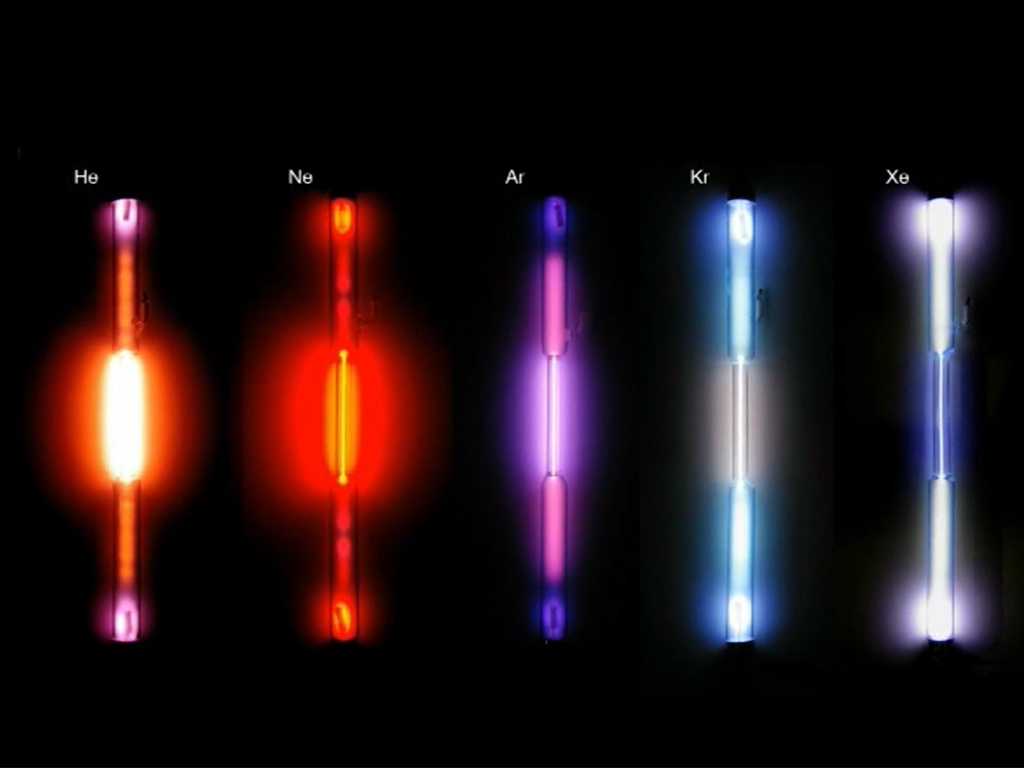
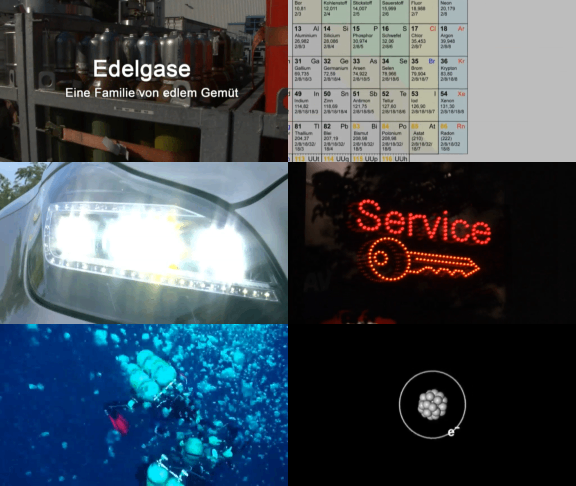
Xenon, Helium, Neon, Argon, Krypton and the radioactive Radon belong to the noble gases. These form the family of noble gases as the elements of the eighth group of the periodic table. All of them are colourless and odourless, non-inflammable and non-toxic. Their most striking chemical property is their inertness. This can be explained by their electron arrangement, termed noble gas configuration and represents a particularly stable and therefore low-energy state. The noble gases are to be found in scant amounts in our air from which they are also distilled. Helium is mainly extracted from natural gas. In everyday life, we encounter noble gases for example as shielding, filling or buoyant gases and in fluorescent tubes. The shell model describes the structure of the atoms. It is based on the distribution of electrons in restricted areas at a fixed distance around the core of the atom.

C, CO2 and Associates in Everyday Life
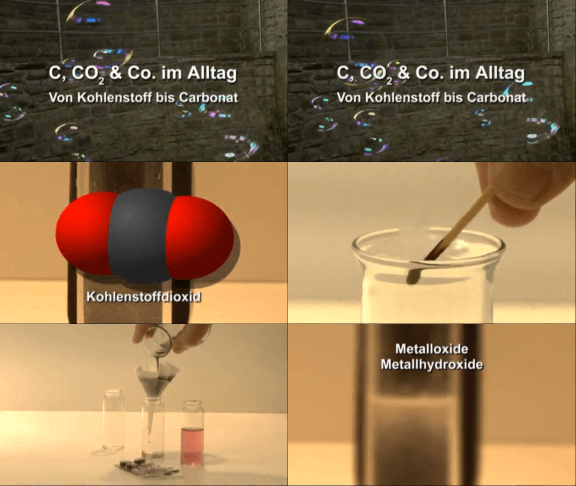
All organic matter contains carbon. Coal is deposited in the Earth's interior. It developed about 300 million years ago from plants in a geological period which is also called Carboniferous. During the combustion of organic matter, carbon turns into the gas carbon dioxide. Dissolved in water, it becomes the so-called carbonic acid. Carbon dioxide is an incombustible, colourless and odourless gas that is easily dissolved in water. With various metal oxides or hydroxides it forms two types of salts: the carbonates and the hydrogen carbonates. As calcium carbonate it is contained in natural products such as chalk and egg shells. Specific forms of carbon, called modifications, are graphite and also the particularly valuable diamond.