







 Technology

4664221 / 5553660
Communication
Radio, Telephone, Television
There is almost no other technical field in which such wide-reaching changes have taken place in recent years as in the field of communication. The film provides impressive evidence of the developments and advances of communication technology. The invention of radio technology, introducing a new era of the transmission of messages, is demonstrated as well as innovations in the field of radio broadcasting and eventually the propagandistic use of radio and television during the Third Reich. Efforts to transmit language are a topic of the film as well as the worldwide success of the telephone which led to the formation of telephone exchanges. The film concentrates just as much on a detailed presentation of the current situation as on a precise description of the bygone era. The advent of television developed by Becquerel, by Nipkow and Braun up to the transition from analog to digital TV broadcasting is made a subject of discussion. Earlier film footage adds to the authenticity and makes past aspects comprehensible. Together with the extensive accompanying material the DVD is ideally suited for use in the classroom.
Play trailer
- <> Languages : DE, EN, TR
- <> Target Groups : Sek I, Sek II
- <> Subject : Technology
- <> Length : 19:16 min
- View in learning platform
Licenses

Curriculum-centred and oriented towards educational standards
Matching

Blogging
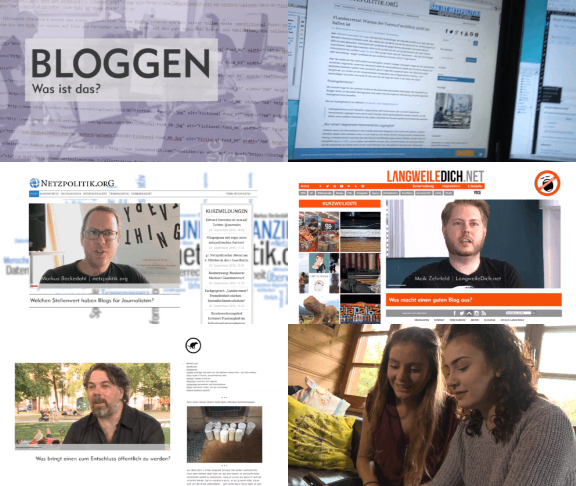
The weblog or blog, for short, as a medium is not much older than this century. Blogs came into being in the World Wide Web as ’messages from below’, as web pages from web creators who wanted to share their view of the world with the world. They are short notes, long texts, pictures, videos, which are posted loosely and at random intervals to the world for an undefined public.
Resuscitation
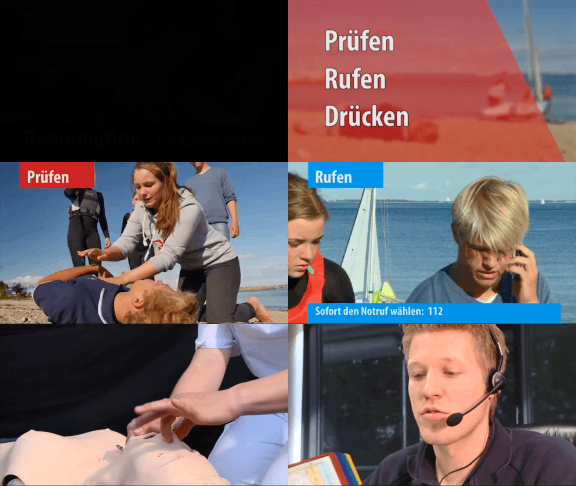
It can happen to anyone – of any age, in any place, at any time. Sudden cardiac arrest may quickly prove fatal. Immediate action is called for! Just remember: Check Call Press Anyone can do it. You can't do anything wrong!

Copyright
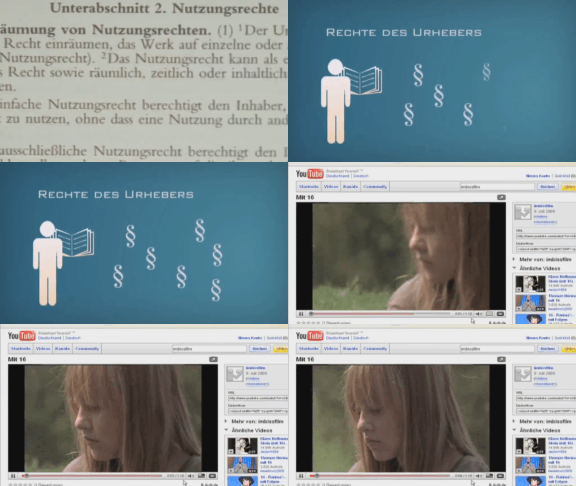
Copyright is subject to constant change to keep up with technological advances. This film enables the viewer to grasp the basic principles of this extremely intricate matter. By way of introduction, the film defines what an author is, what kinds of works there are and how long a work is protected on principle. Then the fundamental rights of an author are cited and it is shown how these are exploited in our times. In the third chapter, the respective rights are illustrated by way of practice-oriented examples of books, photos, music and films. Here, of course, an emphasis is laid on the field of education, taking into account the latest case law within the EU and Austria in particular. A further chapter highlights the problems arising with the Internet and goes into the citation law and pirate copies. All in all, in this way the viewer is made familiar with the most important basic terms and their meanings. Comprehensive worksheets and additional accompanying material invite us to deepen our knowledge of the subject.