







 Chemie

55508960
Kunststoffe
Chemie 9-10
Die Schülerinnen und Schüler haben ein fundiertes Verständnis für die faszinierende Welt der Kunststoffe entwickelt. Sie haben gelernt, dass Kunststoffe eine vielfältige Gruppe von Materialien bilden, die in unserem täglichen Leben weit verbreitet sind. Diese lassen sich strukturell von anderen Stoffen ableiten und weisen eine beeindruckende Bandbreite von Eigenschaften auf, darunter ihre Flexibilität, Härte und Beständigkeit. Dabei haben sie erkannt, dass Kunststoffe sich durch ihre polymere Struktur auszeichnen. Die Schüler/-innen haben verschiedene Arten von Kunststoffen, ihre Eigenschaften sowie ihre zahlreichen Anwendungen kennengelernt und sind nun in der Lage, die Bedeutung dieser Materialien in unserer modernen Welt zu schätzen. Anhand von konkreten Beispielen wie der Herstellung von Plastikflaschen, der Verwendung von Kunststoffen in der Medizin und im Bauwesen sowie den Umweltauswirkungen von Plastikmüll haben sie erkannt, wie Kunststoffe unseren Alltag beeinflussen und welche Herausforderungen im Umgang mit ihnen bestehen.
Beinhaltete Aufgaben
- Video: Kunststoffe - Vorwissen aktivieren
- Video: Kunststoffe- Einführung
- Aufgabe: Kunststoffe - Verständnissicherung
- Video: Kunststoffe - Erarbeitung
- Aufgaben: Kunststoffe - Üben und Anwenden
- Video: Kunststoffe - Vertiefung
- Video: Kunststoffe - Ergebnissicherung
- Aufgaben: Kunststoffe - Teste dein Wissen I
- Aufgaben: Kunststoffe - Teste dein Wissen II
- Kunststoffe - Merkblatt
Lehrplanzentral und an den Bildungsstandards orientiert
Passend dazu
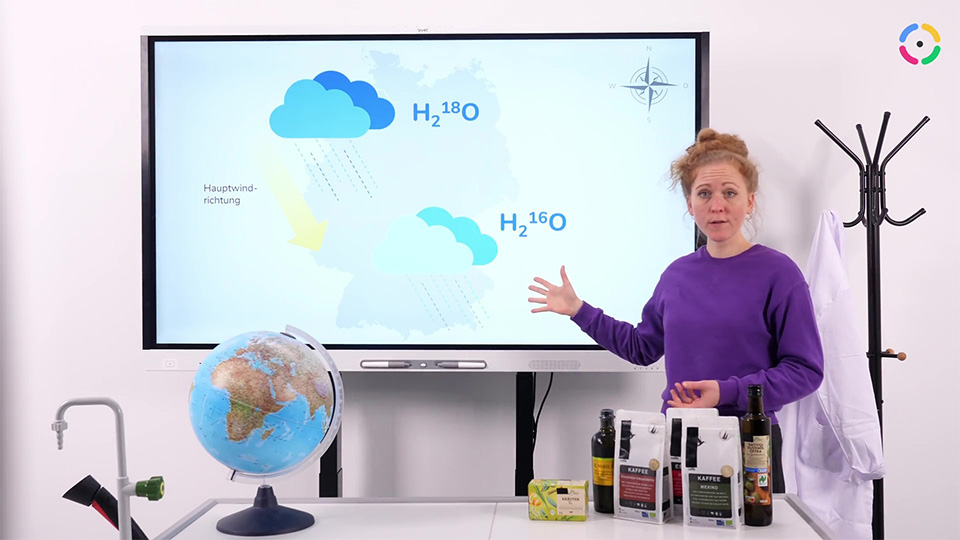
Isotope
Zehn interaktive H5P-Aufgaben, die den Ablauf einer Schulstunde nachvollziehen, erklären in Videos Atomaufbau und Isotope und sichern das Wissen mit Aufgaben ab.
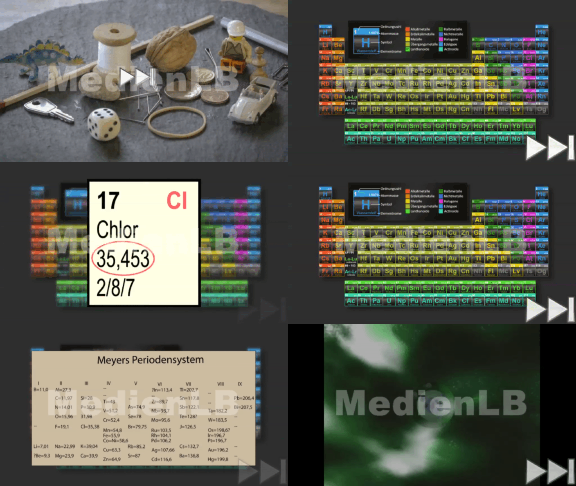
Periodic Table
With the help of the periodic system chemists can predict properties of chemical elements and derive chemical reactions. But you need not be a chemist to understand the periodic system.

Halogens
The compounds of halogens are - with the exception of astatine - widespread, can be encountered in nature and are versatile substances. This fact is taken up on this DVD in order to teach the students the chemistry of the halogens by illustrating their special qualities and explaining the correlation of their structure with their chemical properties. In the first part, an overview of the element group of halogens lays emphasis on the common as well as on the distinguishing characteristics of fluorine, chlorine, bromine and iodine. In a second part, the specific properties of fluorine and chlorine are presented. This topic is linked to the students‘ everyday experience (fluorine as a protection against caries, chlorine as a disinfectant, etc.) on the one hand. On the other hand, the DVD presents carefully selected experiments. As a rule, they are of a kind that can only be realized with difficulty, or high expenditure in the chemistry classroom. With the help of these experiments, students are introduced to the chemistry of the halogens in a way that enables them to draw conclusions on the basis of their observations.
