







 Gesellschaft


4677312 / 5564520
Wegwerfgesellschaft
In die Tonne – aus dem Sinn!
Allein in Deutschland landen jedes Jahr elf Millionen Tonnen Lebensmittel im Müll. Würde man diese Menge Lebensmittelabfall in Lkws verladen, so ergäbe sich eine Lkw-Schlange, die von Berlin bis nach Peking reichen würde.
Und für einen kleinen Teil davon ist auch Familie Nicosia aus Köln verantwortlich. Der Film begleitet die siebenköpfige Familie eine Woche lang, um zu dokumentieren, wie viel Essen bei ihnen in der Mülltonne landet.
Viel Geld verschwindet beim Essen. Teuer eingekaufte Lebensmittel, die dann ungegessen im Müll landen. In der Tonne – aus dem Sinn. Dass Essen einfach so im Müll landet, ist kein Phänomen, das nur bei Familie Nicosia vorkommt. Die meisten von uns würden zu derselben Erkenntnis gelangen. Der Film erklärt, wo die Probleme entstehen und wie man,
z. B. durch planvolles Einkaufen, die Lebensmittelverschwendung vermeiden bzw. stark reduzieren kann.
Gemeinsam mit dem sehr umfangreichen Unterrichtsmaterial (klassische und interaktive Arbeitsblätter und Testaufgaben) ist der Unterrichtsfilm sehr gut für den Einsatz im Unterricht geeignet.
- <> Sprachen : DE
- <> Zielgruppen : GS, Sek I
- <> Fach : Gesellschaft
- <> Spieldauer : 14:07 min
- In Lehrmediathek ansehen
Lizenzen

Lehrplanzentral und an den Bildungsstandards orientiert
Passend dazu

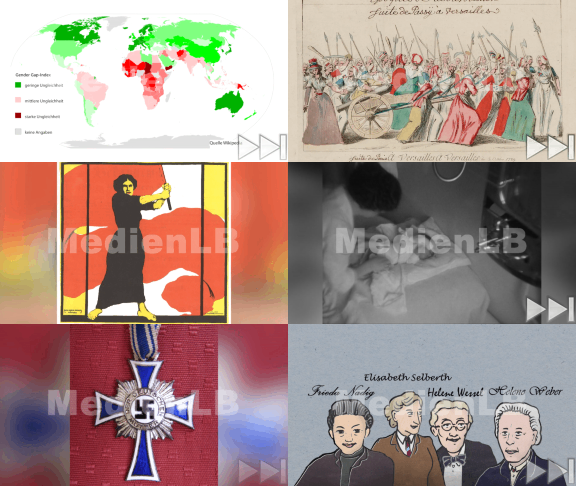
Gleichstellung der Geschlechter
„Männer und Frauen sind gleichberechtigt.“, so steht es im deutschen Grundgesetz in Artikel 3. Doch leben wir tatsächlich in einer geschlechtergerechten Gesellschaft? Der Film gibt darüber Aufschluss. Für den Unterricht empfohlen!


Saisonal und gesund kochen
Selber kochen macht Spaß und mit saisonalen und regionalen Zutaten tut man auch etwas für die CO2-Bilanz.


Altersarmut
Innerhalb von 52 Jahren hat sich in der Bundesrepublik das Verhältnis von Beitragszahlern für die Rente zu den bestehenden Rentnern um den Faktor 3 verschlechtert. Sind 1962 noch 6 Erwerbstätige für die Rentenzahlung eines Rentners aufkommen, so mussten 2014 zwei Erwerbstätige für die Rentenzahlung von einem Rentner aufkommen. Die Altersarmut in Deutschland steigt. Denn nur wer 40 Jahre ohne Unterbrechung mindestens 2.100 € verdient hat, bekommt als Rente mehr als den Hartz-IV-Satz ausgezahlt. Beschäftige im Niedriglohnsektor oder in Teilzeit können selbst nach 45 Jahren Arbeit nicht von ihrer Rente leben. Vielen Rentnern bleibt nur der entwürdigende Weg zum Arbeitsamt.
