







 Gesellschaft

46505318 / 55505932
Permakultur
Definition, Umsetzung, Nachhaltigkeit
Permakultur bezeichnet die Philosophie einer Landwirtschaft, die sich an den Prozessen der Natur orientiert und für Nachhaltigkeit steht. Entwickelt wurde es von den Australiern Bill Mollison und David Holmgren in den 1970er Jahren. Es fußt auf drei ethischen Prinzipien: Earth Care, People Care und Fair Share. Der Film zeigt Elemente der Permakultur und begleitet ein Gartenjahr über alle Jahreszeiten hinweg. Aufgezeigt wird u.a., wie Wärme- und Wasserspeicher errichtet, Böden locker und fruchtbar gehalten und Permakulturbeete angelegt werden.
Interaktive Aufgaben, Testfragen und Glossar wurden mit H5P erstellt und können ohne weitere Software verwendet werden.
Trailer abspielen
Lehrplanzentral und an den Bildungsstandards orientiert
Passend dazu
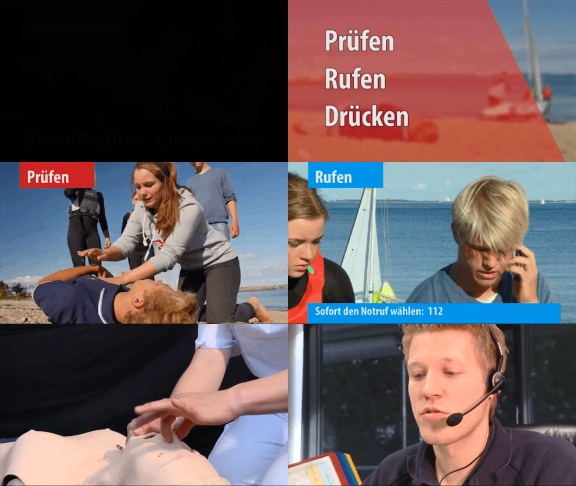
Resuscitation
It can happen to anyone – of any age, in any place, at any time. Sudden cardiac arrest may quickly prove fatal. Immediate action is called for! Just remember: Check Call Press Anyone can do it. You can't do anything wrong!


Mobile Learning II
Oh, what’s that? Original soundtrack Thissen: “As our children grow up in a media world and naturally handle the media, they should also be a topic in school.“ An older child says the point is that they don’t just load down apps but create things themselves that haven’t existed so far. Hi, I’m Jana. A propeller hat. I’ll put it on. Now I’m no longer a simple rhino, but a flying rhino. Original soundtrack Thissen: “It’s exactly the great flexibility of tablets that promotes very personalised and adapted learning.” Original soundtrack Welzel: “It’s fascinating to see how the children grow with their products and how they always want to improve them.” The Westminster Abbey is a church in London for the royal family. Original soundtrack Welzel: “And?“ They think it is ok.

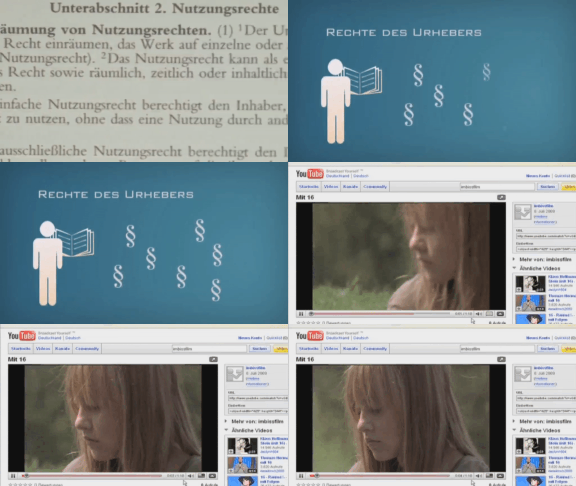
Copyright
Copyright is subject to constant change to keep up with technological advances. This film enables the viewer to grasp the basic principles of this extremely intricate matter. By way of introduction, the film defines what an author is, what kinds of works there are and how long a work is protected on principle. Then the fundamental rights of an author are cited and it is shown how these are exploited in our times. In the third chapter, the respective rights are illustrated by way of practice-oriented examples of books, photos, music and films. Here, of course, an emphasis is laid on the field of education, taking into account the latest case law within the EU and Austria in particular. A further chapter highlights the problems arising with the Internet and goes into the citation law and pirate copies. All in all, in this way the viewer is made familiar with the most important basic terms and their meanings. Comprehensive worksheets and additional accompanying material invite us to deepen our knowledge of the subject.
